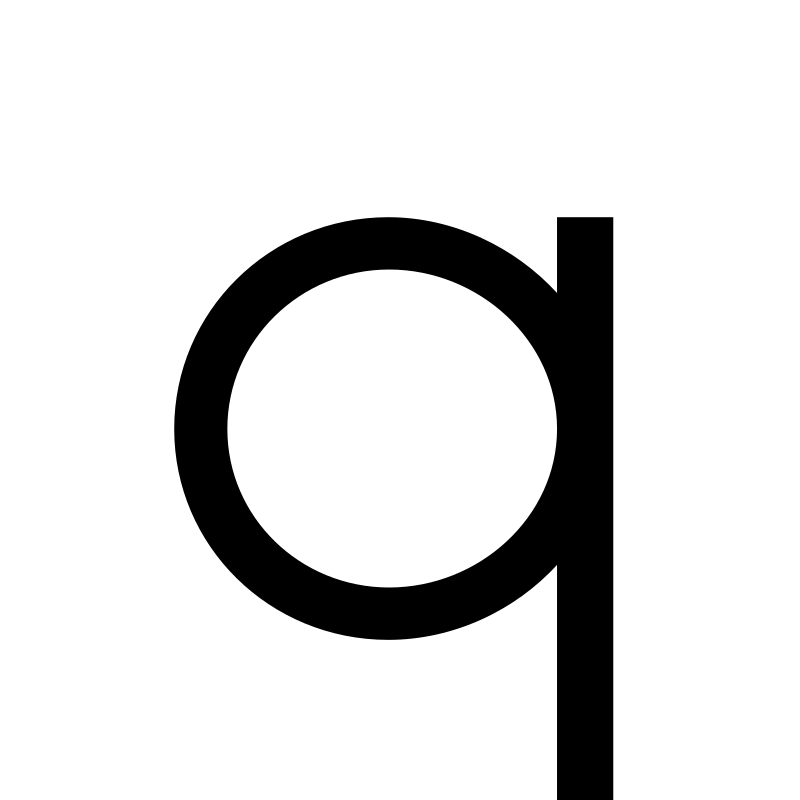
Los vectores Q se utilizan en dinámica atmosférica para comprender procesos físicos como el movimiento vertical y la frontogénesis. Los vectores Q no son cantidades físicas que se puedan medir en la atmósfera, sino que se derivan de las ecuaciones cuasi-geostróficas y se pueden usar en las situaciones de diagnóstico anteriores. En los gráficos meteorológicos, los vectores Q apuntan hacia el movimiento hacia arriba y hacia el lado opuesto al movimiento hacia abajo. Los vectores Q son una alternativa a la ecuación omega para diagnosticar el movimiento vertical en las ecuaciones cuasi-geostróficas.
Derivaciones
First derived in 1978,[1] Q-vector derivation can be simplified for the midlatitudes, using the midlatitude β-plane quasi-geostrophic prediction equations:[2]
- (x component of quasi-geostrophic momentum equation)
- (y component of quasi-geostrophic momentum equation)
- (quasi-geostrophic thermodynamic equation)
And the thermal wind equations:
(x component of thermal wind equation)
(y component of thermal wind equation)
where is the Coriolis parameter, approximated by the constant 1e−4 s−1; is the atmospheric ideal gas constant; is the latitudinal change in the Coriolis parameter ; is a static stability parameter; is the specific heat at constant pressure; is pressure; is temperature; anything with a subscript indicates geostrophic; anything with a subscript indicates ageostrophic; is a diabatic heating rate; and is the Lagrangian rate change of pressure with time. . Note that because pressure decreases with height in the atmosphere, a negative value of is upward vertical motion, analogous to .
From these equations we can get expressions for the Q-vector:
And in vector form:
Plugging these Q-vector equations into the quasi-geostrophic omega equation gives:
If second derivatives are approximated as a negative sign, as is true for a sinusoidal function, the above in an adiabatic setting may be viewed as a statement about upward motion:
Expanding the left-hand side of the quasi-geostrophic omega equation in a Fourier Series gives the above, implying that a relationship with the right-hand side of the quasi-geostrophic omega equation can be assumed.
This expression shows that the divergence of the Q-vector () is associated with downward motion. Therefore, convergent forces ascent and divergent forces descend.[3] Q-vectors and all ageostrophic flow exist to preserve thermal wind balance. Therefore, low level Q-vectors tend to point in the direction of low-level ageostrophic winds.[4]
Aplicaciones
Los vectores Q se pueden determinar completamente con: altura geopotencial ({\ estilo de visualización \ Phi}\Fi) y la temperatura en una superficie de presión constante. Los vectores Q siempre apuntan en la dirección del aire ascendente. Para un ciclón y anticiclón idealizados en el hemisferio norte (donde ), los ciclones tienen vectores Q que apuntan paralelos al viento térmico y los anticiclones tienen vectores Q que apuntan antiparalelos al viento térmico.[5] Esto significa movimiento hacia arriba en el área de advección de aire cálido y movimiento hacia abajo en el área de advección de aire frío.
En la frontogénesis, los gradientes de temperatura deben ajustarse para la iniciación. Para esas situaciones, los vectores Q apuntan hacia el aire ascendente y los gradientes térmicos cada vez más estrechos.[6] En áreas de vectores Q convergentes, se crea vorticidad ciclónica, y en áreas divergentes, se crea vorticidad anticiclónica.[1]
Referencias